Description

1. TLDR
- Cosmos for Humanity is the first NGO officially recognised as being of public utility in the field of sustainable development of space activities.
- Our mission is to enable citizens to become stakeholders in the preservation of the orbital environment.
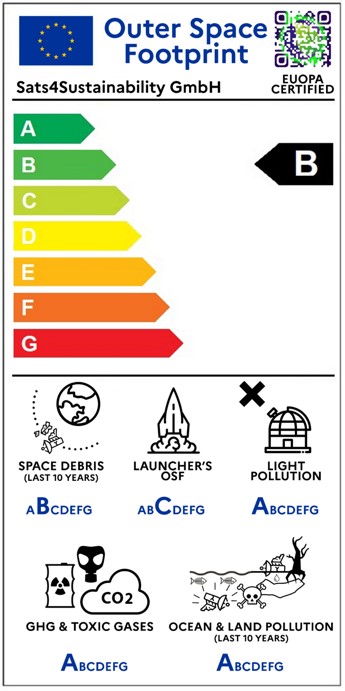
- We have been incubated as part of a partnership with CNES, the French space agency, to develop the Outer Space Footprint, an indicator that aims to enable citizens and companies to compare the environmental impact of the space activities of all actors.
- We are developing the first sustainability label enabling citizens to carry out the certification process themselves, using blockchain to guarantee the transparency, forgery-proofness and neutrality of the process.
- Since January 2024, our NGO has been hosting the "SpaceDAO" project, developed in partnership with the European Space Agency (ESA), which aims to offer an orbital traffic management platform based on operator consensus rather than trust.
- We have been defending the sustainable development of space activities on Gitcoin since GR15 and our participation in the first founder's circles of ReFiDAO.
- Everything you need to know about C4H and outer space pollutions is now available on our Cosmos Rangers' workspace on Charmverse (in French, and in English by the beginning of GG20).
2. THE PROBLEM

Today, our world is so dependent on satellite data that our civilisation would falter if we lost our access to space. In particular, we would lose access to observation data that plays a key role in monitoring and fighting climate change.

What if every satellite suddenly disappeared?
Yet this access to space does not come without environmental trade-offs. Sending satellites and rockets into space creates a great deal of pollution: light, atmospheric, terrestrial, oceanic, but also in orbit. These pollutions are currently very poorly documented, so that public authorities and the space industry sometimes act as if they didn't exist.

This environmental impact is now threatening our access to space itself. The Kessler syndrome, the fear that collisions of space debris will lead to a chain reaction of collisions, is already a reality in low orbits between 800 and 1000 km.
There is a risk that these orbits will become unusable.

Worse still, the proliferation of megaconstellations and the number of satellites in orbit is automatically leading to an increase in the number of uncontrolled satellite crashes. According to a report from the US Federal Aviation Administration (FAA), there will be almost one victim every two years by 2035.
Faced with this situation, the reaction of public authorities is limited to issuing "guidelines" and good practices, without being able to establish binding rules for all operators. In fact, to enact truly binding rules, an international treaty would be needed, the fruit of a consensus between states. Today, however, these nations prefer to play the "Zero Sum Game" in orbit, trying to monopolise certain orbits here and certain resources there.
Faced with a global problem, we need a global response. So we are proposing to think "out of the Space Box" and reshuffle the deck by calling on two players who currently have no say in the matter: citizens and businesses.
Why should we do this?
Because it's a simple application of game theory: public authorities and the space industry have no incentive to act or to change their behaviour in the short term.
- From the point of view of the public authorities, in the event of a severe deterioration in the environmental situation, the space industry will very probably be financed by contracts to attempt to remove the debris. Since this is a public order, and therefore involves public money, it will be citizens and companies outside the space industry who will have to pay for it, through their taxes.
- From the space industry's point of view, if the cost of operating orbits increases because of space debris congestion, it will still be possible to increase the price of data access for companies and citizens, or even to benefit from public aid, financed by taxation. So also paid by companies and citizens.

If nothing is done, citizens and companies are losing out every time. So we need to change the rules of the game by making them concerned by the sustainability of space activities.
3. OUR SOLUTION
The mission of our NGO is dual:
- On the one hand, to enable citizens to play an active part in preserving the orbital environment.
- On the other hand, to enable companies to produce environmental impact in space and to take concrete action to preserve the access to space on which they are economically dependent.
How can we do this?
When we make donations to Jimi of Treegens, we fund his work to preserve mangroves, so we have a direct impact on the environment. We have the same objective, but for orbits.
Thanks to donations from companies, we are making an impact in terms of space sustainability. We enable them to mitigate this ESG risk by reclaiming the impact we have produced pro rata to their donations.
Today, we are enabling citizens and businesses to understand the problem of space pollution and to get organised to start tackling the problem. Thanks to the Outer Space Footprint, we will soon be able to identify bad operators, enabling companies to favour responsible operators to reduce their legal, reputational and financial risks.
Tomorrow, our aim is to become the "Red Cross of Space", by financing debris removal operations by players like Astroscale. Or even carrying them out ourselves, with the help of partner start-ups. At the same time, financial support for Space DAO will enable decentralised and optimised management of space traffic, making it a positive-sum game for the various players involved. By funding SpaceDAO through C4H, companies, even those outside the space industry, will be able to make a tangible impact on the preservation of the orbital environment.